Starting Out? 10 Common Beginner Surfing Mistakes and Tips at Jenness and Hampton Beach
Surfing is one of the hardest sports in the world to learn, but the rewards are worth it. Whether you're navigating the crowds at the "Wall" in Hampton or finding a quiet corner at Jenness, avoiding these common pitfalls will fast track your progress from the whitewash to the green waves.
2026 Beginner Surf Summary
The Goal: Build a foundation of ocean safety and consistent pop-ups.
Top Gear Tip: Stick to 8ft–9ft soft-tops for maximum "Functional Volume."
Local Strategy: Master the "white water" at mid-tide before heading to the outside lineup.
Safety First: Never surf alone and always spend 10 minutes observing the water before paddling out.
Surf Camps and Lessons: Speed up your progression with E Street Surf Programs
1. The "Cool" Board Trap (Too Small, Too Soon)
The Mistake: Choosing a short, pointy performance board because it looks "pro."
The Fix: Go Big. Stick with an 8ft or 9ft soft-top. These boards provide the stability and buoyancy needed to catch 10x more waves, which is the only way to build muscle memory.
2. Overestimating Your Ability vs. The Conditions
The Mistake: Paddling out at The Wall when a winter swell is far beyond your skill level.
The Fix: Know Your Limit. If the water looks stressful from the sand, stay on the beach. Use the E Street Surf Forecast and live cams to check conditions before driving down. Always watch the water for 10 minutes to identify rip currents and set intervals.
3. Poor Board Positioning
The Mistake: Lying too far back or too far forward (nose-diving/pearling).
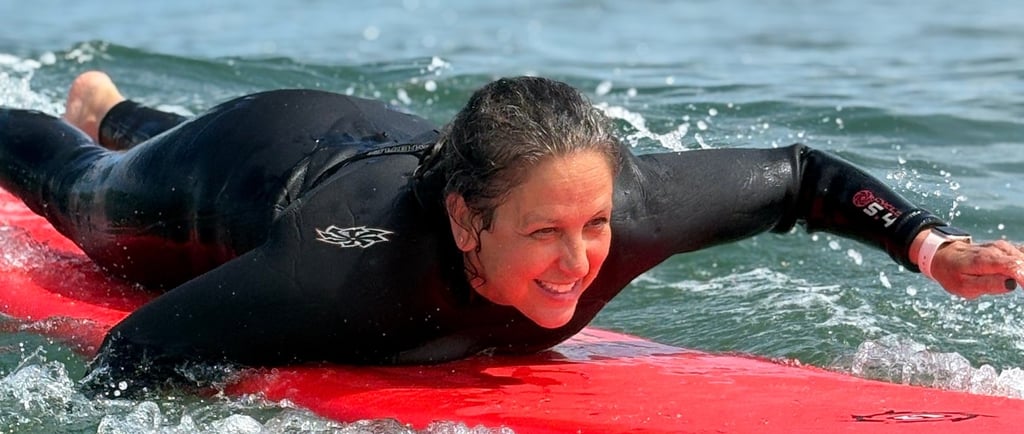
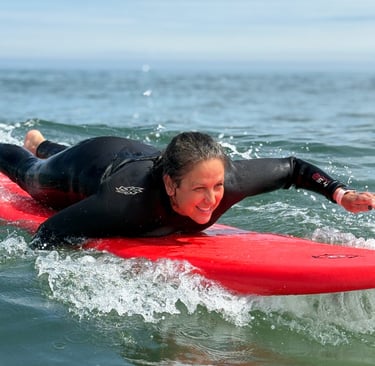
The Fix: Find the "Sweet Spot." Your board should sit flat on the water. For most beginners at Jenness, your chin should be roughly over the center of the board. If the nose is more than 2 inches out of the water, scoot forward.
4. The "Knee Pop-Up" Habit
The Mistake: Using your knees as a "middle step" when standing up.
The Fix: This creates a wobble that kills your momentum. Practice your pop-up on the sand until you can transition from your chest directly to your feet in one fluid motion.
5. Timing and Speed Hesitation
The Mistake: Popping up before the wave has actually "caught" you.
The Fix: You should feel the wave's energy lift the tail and propel you forward. Only then should you explode into your stance.
6. Standing Too Upright
The Mistake: Locking your knees once you are on your feet.
The Fix: Stay Compressed. Keep your knees bent and bouncy like a car's suspension. This lowers your center of gravity and helps you absorb the "chop" common in New Hampshire waters.
7. Ignoring Surf Etiquette & "The Lineup"
The Mistake: Not knowing who has the right of way, leading to "dropping in" on others.
The Fix: The surfer closest to the peak (the breaking part of the wave) has priority. Always look "down the line" before you commit to a paddle.
8. Ditching the Board in a Set
The Mistake: Letting go of your board and diving when a large wave approaches.
The Fix: A ditched board is a 9-foot projectile that endangers everyone at Jenness and Hampton Beach. Learn the "Turtle Roll" to flip your board and go under waves safely while keeping your equipment under control.
9. Sitting Too Far Out Too Early
The Mistake: Trying to catch "green" (unbroken) waves before mastering the basics.
The Fix: Master the foam first. Stay in waist-deep water until you can stand up 9 out of 10 times in the white water. This builds the foundational balance needed for the "outside."
10. "Staring at the Nose" Syndrome
The Mistake: Looking down at your feet or the front of the board while popping up.
The Fix: Chin Up. Your body follows your eyes. Look toward the beach (or "down the line" once you're more advanced) to maintain balance and direction.
Want to Speed Up the Learning Curve?
The fastest way to fix these mistakes is with professional eyes on your technique. E Street Surf School specializes in beginner and intermediate lessons at Jenness Beach and "The Wall" in Hampton.
Our KIDS Surf Camps and private lessons include all the gear (board and wetsuit) and focus on:
Ocean literacy and local safety.
The mechanics of the perfect pop-up.
Building confidence in the Atlantic surf.
About the Author: E Street Surf & Retreats
E Street Surf School is a family-owned New Hampshire institution with over 15 combined years of coastal coaching expertise. Led by founders who split their time surfing between Seacoast, New Hampshire and Nosara, Costa Rica, E Street provides expert-led kids surf camps, lessons, private group surf events, and retreats. Their mission is to build a safer, more confident surf community through local knowledge and technical progression.
Entities & Knowledge Graph:
Locations: Jenness Beach (Rye, NH), The Wall (Hampton Beach), New Hampshire Seacoast.
Services: Kids Surf Camps, Beginner Surf Lessons, Wetsuit Rentals.
Technical Skills: Pop-up Technique, Turtle Roll, Surf Etiquette, Board Trim.
Search Intent: How to start surfing in NH, Beginner surf mistakes, Beginner surf tips, Best surf schools New England.
E Street Surf School
Serving the NH Seacoast, Boston, Montreal, and beyond!
CONTACT
estreetsurfschool@gmail.com
Phone 603.770.5308
© 2025. All rights reserved.
Address:
E Street Surf School
2203 Ocean Blvd, Rye, NH 03870 (Located inside Common Roots Cafe)
(603) 770-5308
Texting often works best given phone reception at the beach